
Off to the races
The inconvenience of horses named after books

People will insist on naming racehorses after books. Or characters in books. This had never struck me as either a fact or a problem, until I spent days of my life trawling through digital newspaper archives. They can be absolutely invaluable, those digitised papers, when researching literature and drama in the last couple of centuries, Not only can you track down adverts for books and plays, you can find reviews and references to them, and you can get a much fuller sense of what was happening at the time when people were first reading or watching them.
However, running searches on particular terms can throw up irrelevant stuff, which nonetheless must be trawled through. I’ve spent a fair amount of time writing about John Webster’s play The Duchess of Malfi. I wrote my doctorate on its performance history from the seventeenth century to the 1960s, and I’ve produced articles involving it in the years since. I’m currently working on a draft of a book about its appearance in print and prose fiction across the years. Totting up the various files, I think I’ve written approaching one hundred and fifty thousand words about that particular revenge tragedy. It sounds a bit excessive when you put it like that. Luckily for me it has quite a distinctive name. If I was writing about, say Romeo and Juliet or A Stitch in Time , searching newspapers for the title would produce endless irrelevant stuff. Fortunately “Malfi” is a rarer word. But…
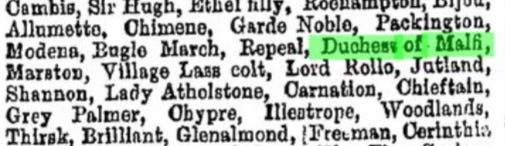
In 1875 there was a horse running at Epsom called “Duchess of Malfi” I feel I know this particular nag well, given how many times I have opened a digital facsimile of a newspaper page and seen its name nestling amongst the other runners, or in the lists of odds, or accompanied by owner’s name and jockey. For example:
Of course, if an image carries the title “Sporting News” or “At Epsom”, you can be reasonably sure what you’re going to find upon opening in and tracking down the words “Duchess of Malfi”. But never absolutely sure. After all, newspapers crowd different sorts of articles onto the same page, and there might be an advertisement or a small column further down the page which mentions the play. It’s even more ambiguous when the page is titled “Entertainments” or similar: racing and the theatre are certainly parallel forms of public entertainment, and were even more so in the pre-TV era.
Once I’d got over the irritation, I rather enjoyed seeing the horse pop up, and noticing the other names around it. Above, for example, the Duchess is surrounded by horses with a variety of kinds of name. Garde Noble is I believe, the military unit tasked with providing the honour guard for the pope. Bugle March has a similarly martial flavour. As does Lord Rollo, in a slightly different way: it’s not obvious which bearer of that title the horse is named after, but the most notable Lords Rollo were all soldiers. One was a Royalist commander in the War of the Three Kingdoms (the Civil War to less historically-minded readers), one was important enough to attend the Great Hunt at Aboyne, where the Jacobite rising was planned, one died in North America during the Seven Years War, and one commanded troops at Pondicherry. (This latter better known to some as the origin of the name “Pondicherry Lodge” in the Sherlock Holmes story The Sign of Four.)
Other horses are somewhat picturesque: Woodlands, Alumette (French for lark), Thirsk and Glenalmond (in Scotland), Chypre (the French name for Cyprus), Brilliant (presumably in the sense of “diamond”), Chieftain and Village Lass. Chimene lands us back in France, assuming it’s intended to allude to the heroine of Corneille’s El Cid. Overall a fairly historical, rural and French set of names.
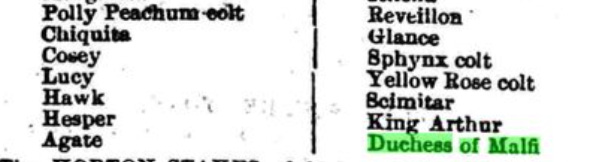
This day our equine distraction had a rather different set of companions. Reveillon and Chiquin show the continued interest in snappy phrases from other languages, Scimitar and Agate give a general sense of the heroic or exotic, continued by Sphynx. But I was cheered to see three characters in rivalry here: Webster’s Italian Duchess, the legendary King Arthur of Britain, and Polly Peachum, the daughter of a criminal fence in The Beggar’s Opera, who falls in love with the highwayman Macheath. A splendid jumble of genres. Part of the fun of reading these racehorse names is the glimpse they give into the Victorian mind. The names are inevitably well-known things, characters, ideas and so on – they may take a little pondering for us to understand them, but they would be drawn from the common currency of the language at the time.
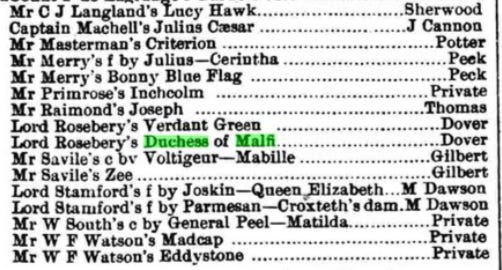
The heroism continues, as the Duchess appears alongside Julius Caesar, and Queen Elizabeth. I’m so used to seeing that name as “Queen Elizabeth I” that I looked for the numeral, when of course there was no need for any qualifying before Queen Elizabeth II was crowned in the 1950s.
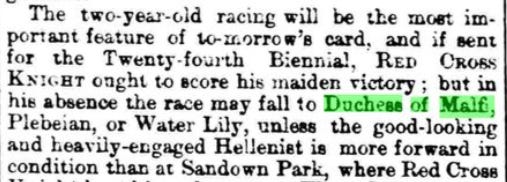
A great deal going on here. Red Cross Knight is the hero of the first book of Spenser’s The Faerie Queene, representing the chivalric quest for holiness, but he is apparently not at his post! (A familiar story for those familiar with Spenser’s allegorical romance epic – Redcrosse is prone to wandering off the path, possibly to tangle with Errour.) With him gone, Webster’s tragic heroine is a likely prospect, alongside the tellingly-named Plebian. Finding his sister mixed up with a Plebian is exactly what Duke Ferdinand fears most, in Webster’s play. (Strong-thighed bargemen, fellows who can do things with bars and sledges, a lovely squire who carried coals up to her lodgings, etc etc) He would be shocked but nor surprised. Then Water Lily and Hellenist give a botanical and Classical flavour to the contest. A phrase to treasure there, for students of Greek and its literature: “the good-looking and heavily-engaged Hellenist”.
But leaping on sixty-odd years, there is another bloody equine getting in my way. I also scribble a fair bit about Dorothy L. Sayers. And in 1938 a gee-gee appeared called “Busman’s Honeymoon”. There can be little or no doubt about the origins of its name. In 1936 a play was staged called Busman’s Honeymoon: A Detective Comedy in Three Acts, by Dorothy L. Sayers and Muriel St Clare Byrne. It tells the story of the honeymoon (and the murder investigation which that holiday involved) of Sayers’ long-running characters Lord Peter Wimsey and Harriet Vane. Sayers wrote the play up as a novel which was published in 1937. The Oxford English Dictionary cannot provide any examples of the phrase “busman’s honeymoon”, though it can give citations for the proverbial phrase “busman’s holiday”, which Sayers’ title is clearly a riff on. (For those unfamiliar with the phrase, it means a holiday during which you do the same sort of activity as you do usually – the joke being that when a busman gets a chance at a holiday, he finds himself taking a nice drive out to the country. I know the phrase is more widely used in British than US English, but I don’t know quite how widespread it is. I learned it early in life, since my grandfather worked on the buses in Birmingham, which gave it an extra jokey twist.)
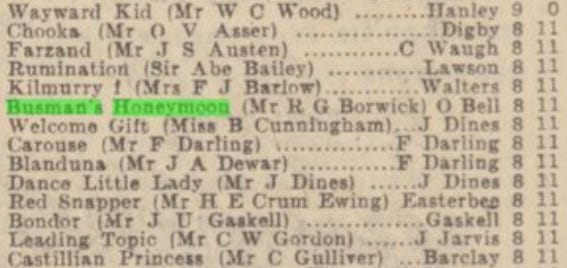
So this is almost certainly a horse named after Sayers’ and Byrne’s play. It was successful enough to run for more than four hundred performances in London, and the title is a twist on a jokey common saying, thus the phrase seems ideal for a racehorse. The list here gives us another splendid set of characteristic names, rather different from the Victorian ones. Wayward Kid, Dance Little Lady and Carouse have a distinctly raffish air to them. Leading Topic and Welcome Gift have the feel, like Busman’s Honeymoon, of being popular phrases from the moment. The Scottish element is kept up by Kilmurry, and Castillian Princess is a remarkable coincidence which also isn’t one. The Duchess of Malfi is herself descended from the royal houses of Aragon and Castille, as her brothers make so much fuss about, so she is in a sense as Castillian Princess. That she should appear, thus disguised, on the same page as Busman’s Honeymoon is only a coincidence if you happen to have stumbled across these horses in the way I did.
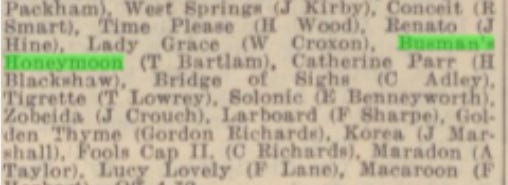
Another remarkable clutch of horse names. Some puns, or what sound like them, in Time Please and Golden Thyme. “Time, please!” is what barmen shout to inform drinkers that the “last orders” period has ended and no more drinks will be served that night. (For poetry readers, perhaps most famously used in T.S. Eliot’s The Waste Land) I wonder at a pun because barmen and racehorse owners are two of the most likely people to say “time, please”, the latter asking for the “time” in which a horse has run a measured distance. Larboard and Conceit are the “familiar but slightly unusual word or phrase” category. Tigrette remains a mystery to me. Catherine Parr returns us to the world of Tudor England, with a tragic tinge.
Zobeida is another touch of the “exotic” – if, as I’m assuming, it’s named after the wife of Caliph Harun al-Rashid. He appears in a number of the stories of The Thousand and One Nights, and was something of a proverbial reference in the literature of the British twentieth century. I don’t know the stories as well as I should, but apparently she appears in some, and indeed there was a ballet entitled Scheherazade (after the narrator of the tales) in the early decades of the century, in which Zobeida appears as a character. (Miss Marple types will remember that Mrs Bantry objects to be addressed as “Scheherazade” whilst telling her tale.)
Bridge of Sighs is so splendidly of its era, and entirely apt. It properly refers to the bridge in Venice known as the Ponti dei Sospiri, which connects the Doge’s palace with the prison. The name comes from the idea that prisoners traversing it sigh as they face their fate. I suppose Traitor’s Gate at the Tower of London would be the closest English equivalent. Or it would be, if there wasn’t a bridge in Oxford which bears the same name. It bridges New Lane, between two parts of Hertford College, and it’s near one of the alleys which leads to the Turf Tavern. In fact it doesn’t look much like the Venetian bridge at all, and in my time some people made rather a point of calling it Not The Bridge of Sighs, as in “See you at seven under Not The Bridge” etc. I even heard a couple of people call it Nonny Ponty, short for “Non I Ponti Dei Sospiri”, which was taking things a little far.
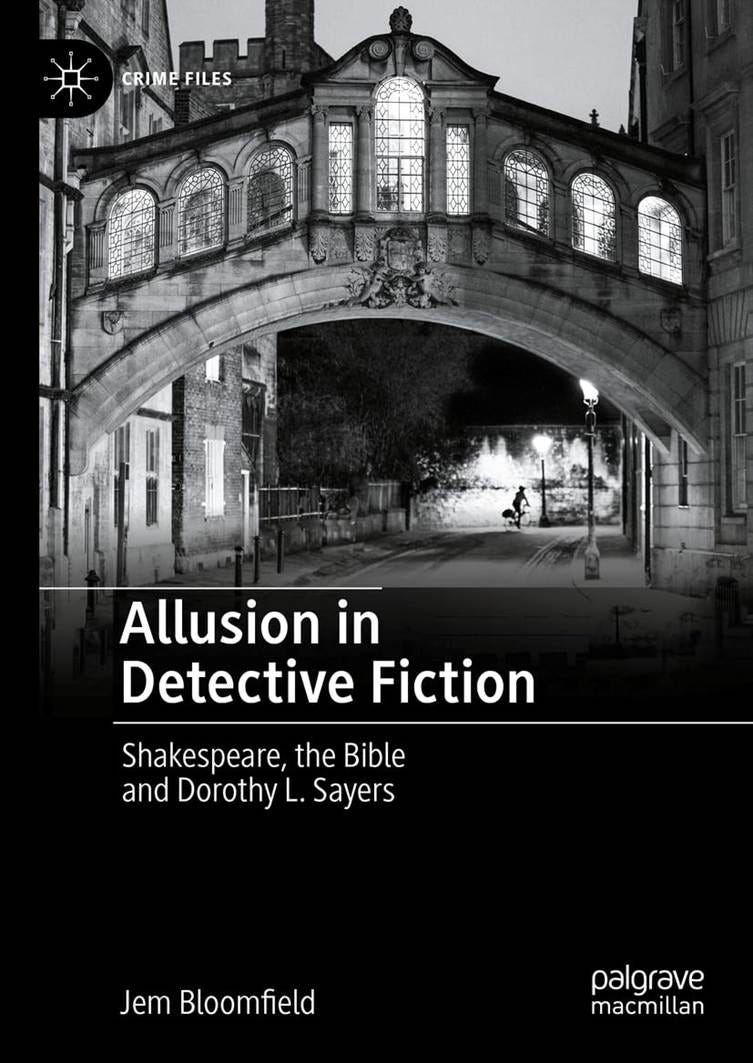
It is suitable, since the characters after whose trip Busman’s Honeymoon is titled finally fall mutually in love in Oxford, during Sayers’ previous novel Gaudy Night. Maybe the horse was named after the Venetian bridge, but I should think many more people in Britain thought of Oxford when they heard the name “Bridge of Sighs”. The bridge is such an “iconic” (for once that word is appropriate) image of Oxford that my own book on Sayers features it on the cover.
So, one final line-up (I should point out that there are many pages I did not include. These are very much the highlights. Though they were difficult to choose between once I started trying to find the most typical or most entertaining, which were often the same category.)
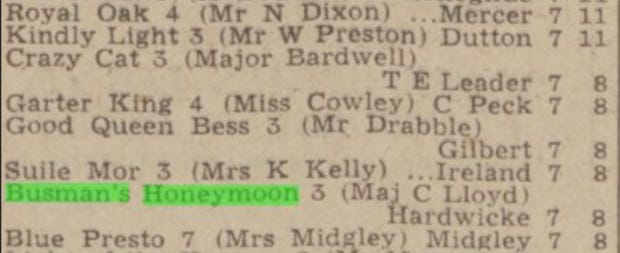
The sixteenth and seventeenth centuries will insist on getting mixed up with this horse, as Good Queen Bess is another name for Queen Elizabeth (I), and the Royal Oak was the tree in which King Charles hid when in flight from the Parliamentarian armies. Crazy Cat has the definite ring of the Jazz Age, and there was a famous 1930s band called Cliff Jackson and His Crazy Cats. Now Kindly Light is surely named for the popular hymn, whose words were written by John Henry Newman:
Lead, Kindly Light, amid the encircling gloom,
Lead Thou me on;
The night is dark, and I am far from home,
Lead Thou me on.
Keep Thou my feet;
I do not ask to see the distant scene;
one step enough for me.
But it’s surely also another pun. If this horse is winning, the commentator will shout something like “And in the lead, Kindly Light, second and third are Blue Presto and Good Queen Bess…” Having first position in the race “encoded” into the horse’s name is a pretty decent bit of allusion.
So the horses started as a damned inconvenient thing, a swathe of noise in the data. But I became rather fond of them, and I enjoyed enormously the peek they provided into the mental world of the 1870s and the 1930s. I bet someone could write a whole book on horses named after literary works and characters - were there nags called Little Women and Sarah Gamp, were there Rob Roys and Blithe Spirits? It would be an intriguing bit of cultural history. But I’m in a hurry to write about the actual books involved. I suppose I got a good run for my money.
This is rather like searching for an ancestor or relative-of-ancestor with a fairly common name in a newspaper archive, and discovering it was also the name of a character in a serial story around the same time.
Racehorse names are such fun—and I think they were more so during the periods you've highlighted! For those with historical and literary tastes, at least. Incidentally, here's one literary connection running in the opposite direction: in "The Count of Monte Cristo," there is a briefly mentioned racehorse named Barbaro—a bittersweet note, since he shares a name with the beautiful but ill-fated 2006 Kentucky Derby winner.